Sunday, August 12, 2012

La crème


I was at the Musée de l'Armée in Paris last week when I realized how...good...the blue in the French flag is.

It's a really elegant, inky blue.  I would have described it as a type of Prussian blue, thinking of my oil painting palette.  Well, did you know that Prussian blue is sometimes called Parisian blue?  And did you know that the red and blue in the French Tricolour come from the city of Paris's coat of arms?

Unlike my own country's flag, the French flag gives me aesthetic pleasure.

I love Paris.  You love Paris.  We all love Paris.  Paris is filled with Americans loving Paris (and speaking French badly).  Why are we all here?

Saying "Paris is so beautiful," doesn't capture it.  I think the reason we all love Paris is that when we go there, we experience a level of aesthetic pleasure in nearly everything that simply does not exist in the lives of those of us who come from these young and pragmatic countries.

One of the first things we did in Paris was go to Hugo et Victor.  How funny is it to feel really and truly understood...by a chocolatier?  That is how I felt when I saw that the exquisite painted chocolates we had purchased were packaged in a...book.  (Sigh.)


And I nearly cried when I opened the little moleskin book and there was a title page!  You know that wonderful feeling when you open the cover of a new book that you expect to be really good?  That excitement and anticipation...  Now add chocolate.  Rapture!


I almost cried again when I turned the title page and discovered...melted chocolate.  Oh, man!  But that's what walking all over Paris in July with a box of chocolates in your purse will get you.  (I won't pretend that I didn't eventually lick the chocolate off the box.)


The thing that I also loved about Hugo et Victor was that the packaging wasn't just empty promises.  The chocolate inside was also very, very good.  Even better was the Earl Grey and milk chocolate macaron that E and I attempted to "share" on the sidewalk outside their shop (which looks and feels like a jewelery store).


Think about that for a second...  Milk chocolate is so much more right than dark chocolate, isn't it?  With Earl Grey.  It would be something else completely.  You need something creamy to counterbalance the oily aromatic quality of the bergamot...but only because it's manifest in a filled cookie.  A bar of chocolate would be something else entirely.  Do you see?

Sigh.  I said to E, "I love this so much.  This is the tippy top of the game right here."  It's like the Olympics of chocolate and pastry-making in Paris.

Take, for instance this Paris-Brest from Patisserie des Reves.  (Funnily enough, the Paris-Brest pastry is named for the Paris-Brest-Paris bicycle race, another athletic competition.)


That, my friends, is hazelnut cream inside those two chewy layers of choux pastry dusted in powdered sugar.  You might think that's the whole story.  It's not.  There's a mind-blowing architectural achievement in this goodie.  The hazelnut cream is itself filled with chocolate.  I didn't know that a big fluffy ball of cream was strong enough to hold another chamber filled with chocolate.  Wow.  Wow and wow.

Beautiful, mind-blowing, and delicious.  I was so blissed-out that I forgot to photograph the chocolate part.  So I have to rely on photos from this blog rhapsodizing about the same ;-)


A big thank you to American (and many times James Beard cookbook award-winner) Dorie Greenspan for recommending these places in the recent Bon Appetit Insider's Guide to Paris.  All of her recommendations hit the spot, including this one for bread...


This beautiful hunk is the 250g of Pain des Amis from Du Pain et Des Idées that I quickly engulfed sitting on a bench near the Canal St. Martin, in the heart of hipster Paris.  I was going to say "this bread is all about texture," but it's not true.  The flavors are absolutely an essential to the soul of this bread.  It has a moist, chewy, salty almost malty mie shielded by a dense, crunchy, shell-of-the-earth crust that is heaven if you are a Maillard reaction fan and can't get enough of that brown flavor.  Mm.

But really, I didn't have to metro all across Paris for crunchy browned baked stuff.  Just down the block from where we stayed in Montparnasse, the modest Fournil de Brézin blew our minds with its divine pain chocolate, which had little bits of that crunchy-crusty-browned-ness at its edges and then was like biting into a little tower of buttery butterfly wings filled with a thin layer of bitter chocolate.


I thought I was going to die.  Why does anyone in Paris do anything else?  

Their baguettes too...  I don't think E had ever had bread like this.  He was head-down in the computer when I first brought him a bite and he experienced that amazing...crunch, chew.  It brought him to his senses.  Now, he's addicted.  Crunch-chew.  Now, we squeeze the bread when we come out of bakeries, in excitement, in anticipation...will it go crunch-chew?  Every day, in the morning, this wonderful bread.


How is it that an ordinary neighborhood bakery produces better bread than the whole of Hong Kong, or the whole of SF, (or the whole of NYC?)?  Maybe it's the fact that there's a government body that regulates (!) bread and pastry makers -- called the Confédération Nationale de la Boulangerie-Pâtisserie Française (CNBPF).  Or maybe because there are many excellent schools that teach the fine art, such as Ecole de Boulangerie et Pâtisserie Paris (EBP) or L’Ecole Ferrandi.  Or maybe because there are approximately 33,000 artisan bakers in France.

I could go a long way down this road...there's a whole stream of research about flour...  Perhaps you already know that you need T55 or T65 flour for a proper baguette?  Or that mills such as Grandes Moulins des Paris and Les Moulins d'Antoine supply some of the best flour (please, someone correct me on this)?  Besides knowing your ash and protein content, you need to know when your flour is milled (within six weeks) and...

Puff, puff.

Did we do anything in Paris beside eating bread?

Well, I almost had a panic attack at the Centre Pompidou, which is one of my absolute most favorite places in the world.  There are so many things I wanted to see, and I was grief-stricken I wouldn't see them all (I didn't).  If you don't already know, the Centre Pompidou is a modern and contemporary art museum started by French president Georges Pompidou, opened in 1977.

Yah, that's right.  A French head of state cared enough about art to personally spearhead the creation of a contemporary art museum.  Can you conceive of that ever happening in the US, where most people respond to abstract painting by saying things like "My kid could do that"?  A***s.  ('Scuze my French.)

The Pompidou doesn't just have works by all of the notable modern and contemporary artists.  It has the best works.  For example, this simple piece "Untitled (last light), 1993" by Felix Gonzalez Torres, thought to be a response to Gonzalez Torres's lover's initial diagnosis with AIDS, counting the hours remaining in each day with the person he loved so much.


Brilliantly installed on the wall opposite was a painting by David Reed, whose subject is also (abstractly) light.  This is "#509, 2002 2004."


But wow, the piece that really blew me away was an installation by Albanian artist Anri Sala that took up the entire first floor gallery.  It consisted of several large movie screens set at angles to one another and with a partially sliced off blinder around each one, so when you were sitting head on looking at one screen, you could just see around the corner of another.


The video interlinked video of a woman humming as she walked rapidly, fearfully through the streets of Sarajevo (not wearing red in order to avoid getting shot), with an orchestra playing the same music in Bordeaux, with a man playing drums in Mexico City (or was it Berlin)...  


My sense of what was going on got mixed up because one screen would be playing and everyone would congregate to watch.  Then, around the corner, another would start up, and someone in the crowd would see it and get curious...as they went over to investigate, the other people would be compelled to move too.  Like a flock of birds. 

Then, around the corner, some snare drums started to vibrate and play by themselves...


And then someone would notice the music grinder embedded in the glass leading to the people on the street outside...


I loved this piece because it gave me a visceral sense of global contagion.  It showed you how, just by one's nature as a human being...that we are moved by music, moved by curiosity, moved instinctively by the movements of other people...we could become caught up in a revolution before we even know it. 

If you have a chance to see Anri's Sala's work, go.  He will represent France at the Venice Biennale in 2013.

The other place that I nearly hyperventilated was the aforementioned Musée de l'Armée.  They have a collection of the most exquisitely-crafted armor I have ever seen -- mostly 16th and 17th century, which is when the French royalty was really spending up a storm.

Description does very little.  Just take a look at this workmanship:


There were so many other amazing things and time is running out for me to finish this post.  So I will just give you the shortlist:

At Notre Dame, exquisite gold and silver relics.  Some supposedly contain actual fragments of the cross on which Christ was crucified (if you believe in such things) and of the crown of thorns.  There were also these more modern ceremonial objects, which were stunningly beautiful.


There was also this delicate hand embroidery on a mitre left by a visiting pope...


And this modern stained glass window which I thought was as beautiful as Notre Dame's famous rose windows.


Then there was the pleasure of re-visiting my favorite Cézanne still lifes at the Musée d'Orsay, like Apples and Oranges, 1899,


or Still Life with Onions, 1896-1898.


And there was the lush grass and the colors of the flower compositions at the Luxembourg Gardens.


There was the ugly-handsomeness of the 17th century Richelieu Wing at the Louvre, built by architect Jacques Lemercier.


And the scale of the view over Paris from the Sacré-Cœur (the interior of the dome of the basilica is pretty amazing too!)


And the scale of the Arc de Triomph (and of Napoleon's ego for having erected such a monument to himself).  I brought E here because I thought he might appreciate seeing another captain overkill at work ;-)


And I was surprised to feel touched visiting the grave of Baron Haussmann at the Père Lachaise Cemetery.


If you're not familiar, Haussmann was the civic planner who, in the mid-19th century, transformed the narrow, crowded streets of Paris into the broad boulevards we all adore.  Interestingly, this article contends that one reason for the broad streets was to make it easier for the army to deal with civil unrest.


After Père-Lachaise, which was leafy and green and dignified, the Catacombs were a shock (and yet, captivating).  The remains of six million Parisians were relocated from cemeteries all over Paris to abandoned limestone quarries underneath the city.  Eventually someone stacked all those shinbones and skulls into walls, creating one of the world's most macabre tourist attractions...


Brrr.  The Catacombs were almost directly under our house!  

Meanwhile our house was hidden behind an ordinary door off a ordinary-looking street.  But when you opened the door, you entered a long open hallway, and then a garden, where there were three large buildings surrounded by flowers and trees.


Up a winding staircase was our flat, with birdsong coming in the windows.  There, in the middle of Paris!


Here's E computing at the table with a bowl of tomatoes and green Provençal figs from the little farmers' market a block away.  In the middle of this big, grand city.  How cool is that!

We did eat out a handful of times...like at Bar de la Croix Rouge where I had a fantastic roast beef sandwich...


Or at Le Comptoir du Relais, where I spotted a new food trend -- tiny crunchy fish eggs in our tomato salad with mint (later, we had fish eggs with burrata at Au Passage).


But mainly we ate in because it was nice at home, and it gave me the opportunity to acquire gorgeous foodstuffs out and about -- like Bordier butter from Breizh Cafe or a brillant Roquefort from Le Grande Epicerie Paris.  (But I also made great finds at the ordinary supermarket, like white fig jam.)


We went many other places and ate many other things.  It's so hard to stop...  

The last thing I want to be sure to remember was the pleasure of window shopping.  Sometimes it was the pleasure of looking at some gorgeous thing I could never buy, like this fantastic pink party dress (one each for my twin nieces)...


And sometimes it was the pleasure of discovering a store devoted to some peculiar thing you would never-ever see in the USA, like this glove shop...


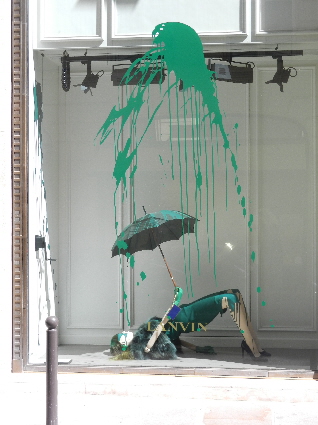
And sometimes it was an outrageous display that stopped me in my tracks (this is tame compared with the Hermes window).


And even though it's not merchandise...sometimes I'd see something through a window that would unexpectedly charm me, like this little dog at Claudine Laurent bakery in Montmartre.


Well anyway, it's a good thing we had to leave after 14 days.  There is no place in the world with a higher concentration of things I adore.  By the end of our stay, I was practically buzzing (and exhausted).  I hope it will fuel me for a long time to come.

Thank you, thank you, thank you, E, for taking me to Paris!

Saturday, July 28, 2012

Ancienne Provence


Sometimes, when you live in a suitcase, you miss funny things.

The other day I was pining for my stove.

When I first moved into my own flat in Cole Valley, I had only water and electricity coming into the house.  No cable, no Internet, no landline.  I had a cell phone and a laptop.  Eventually I discovered that the grill top of my Occidental Automatic was the best place in the house to compute...maybe it was my imagination, but it sure *seemed* like that hunk of metal helped me pick up free Wifi connections more easily.  And it was more comfortable to type standing up.

That stove was also comforting.  I mean, when you're feeling blue, who doesn't want to sit down with their back against warm oven doors and breathe in the smell of baking bread...

I like old things.

Maybe that's why I'm liking Provence so much.

Two days ago, hoofing it up a steep street toward the Abbaye St-Victoire, which LonelyPlanet refers to as "the birthplace of Christianity in Marseille," I felt an itch in the center of my left palm.


Oh, come on!  Stigmata?  I'm not even religious!  (But for sure this place is under my skin.)  Did you know that Marseille is 2600 years old?  The Abbaye toward which I was climbing was founded in the fifth century, but modern times (you know, 14th century whipper-snappering) left their mark as well.  This ancient lump of stones is now partially shrouded in scaffolding and partially serving as a small urban weed garden.


It was hot, really, really, really hot, that day.  Not friendly sparkly sunshine.  Nuclear bomb sunshine.  I was considering the chain of events that would be set off if I collapsed of heat stroke in Marseille while E was computing at home in Aix when I finally located a shady street and happened upon this thing.


What *is* that?  Snow White's glass coffin with a telephone inside?

And on the other side of the street...have they really painted the name of that office in flowing script right over the stonework?


Maybe that glass chamber is a time machine.

I don't know, but I need a snack.  This is all too much for me...


Oh yes, thank goodness we're in France.  Flaky pastry covered in granulated sugar baked until the edges had carmelized almost to the point of burning and then...mmm almond creamy filling.  Thank you, France, for this moment.  Actually, thank you, Pâtisserie Saint Victor.

This was not the only restorative goody I consumed in Marseille.  Incidentally, did you know that the word "restaurant" comes from the French verb restaurer, to restore?  Before restoring myself with almond pastry, I had restored myself with lavender-honey (one flavor) and pistachio (other flavor) ice cream from Maison de la Glace.


Lavender ice cream could be a Provençal party trick, but this was not that.  It was intense, but both the honey and the lavender were intense.  So it tasted as one herbal, earthy note.  In my opinion, it's rare that the flavor of an ice cream can really stand up to the richness of the medium, but...well, this flavor had a right to be ice cream.

Old ways...

Getting off the train in Marseille, I immediately sensed that this was a very different culture from that of Aix.  Men and women were not walking together on the street.

I walked into a Tunisian sandwich shop south of the train station, politely greeted the proprietor, waited my turn, and ordered my sandwich without fanfare.  I was dressed modestly.  Nonetheless, the man behind the counter was visibly pained by my presence.  Later, searching for a spot of shade to eat my lunch...I was afraid to approach benches or ledges where groups of men were sitting together because their body language was so...fearful.  There were no women sitting in the shade.  In the end, I ate my sandwich standing up.


Marseille was chosen Europe's Capital of Culture for 2013.  So they are investing big bucks sprucing up the city's monuments and putting on lots of events.  A recent Guardian article wondered how Marseille would navigate its gang-related drug problems ("20 drug-related assassinations in nine months").  Interestingly, a Nytimes discussion thread asks a contrasting question, "Why has Marseille been so quiet? Are we seeing a model of peaceful integration that could be repeated elsewhere in Europe and globally?"

I wonder how Marseille will navigate receiving visitors who might not be prepared for the fact that the city is close to having a Muslim majority.  The typical visitor to Provence has visions of lavender fields, Cezanne paintings, and sun-dappled farmers' markets dancing in their heads...  They're probably not prepared for the possibility that seeking direct eye contact with a man in a sandwich shop (to see if he understands their faltering French) will freak him out.  Later, said visitor will read "In many [Muslim] societies, making eye contact is an act of hostility and challenge."

Wonder if that was it...  

So I was not ready for Marseille.  And it sure felt like Marseille wasn't ready for visitors.  No garbage cans, no toilets, no shade, no information leaflets in English; weeds growing on their ancient monuments...  I loved it!  Struggling through the heat stroke, I only managed one afternoon there, but wished for more time.  Especially since ferries from Corsica and Sardinia leave from there...


So Provence...do you think of North Africans, Corsicans, Sardinians?  What about Gypsies (or Roma)?  I met a man in HK who was from Provence.  More specifically he is from the tiny town called Saintes Maries de la Mer, the capital of the Camargue.  He told me, "You must go there," and "If possible, go to the Feria du Cheval."

You see, the Camargue is famous for its white horses...and its bulls.  The Camargue is a protected wetland and Western Europe's largest river delta, with more than 300 square miles of open space.  But that really doesn't tell you a lot.  I thought the Camargue was one of the most beautiful natural places I've ever laid eyes on...


It's something about the clearness of the air, the brilliance of the green-blue-and-white, the quality of the sunshine...which drenches everything with light...the clouds that skate along the horizon.

You drive away from Arles for a surprisingly long way (30-40 km) into this void of grass and sky.  As I went farther and farther in, I realized how soothing it was to be in such a simplified space.  If you think about the densest part of Hong Kong...Yau Ma Tei on a Sat...or Central at rush hour... 


This is the opposite of that.

Refuge for the detail-oriented.

At the end of the road is a town filled with little white cottages with thatched roofs and a bare-bones beach.  

 Though it has only about 2000 residents, this town has been here in some form since the 4th century.  There are relics of three saint Maries here -- Magdalene, Salome, and Jacobe -- hence the plural Saintes Maries.  Legend has it, the three Maries came here in a boat over the Mediterranean with Magdalene's daughter Sara, who became the patron saint of Gypsies.  At the end of May Gypsies pilgrimage to Sts Maries to take the relic of Saint Sara out to the sea.

If you ever see this symbol, it is from the church in Stes Maries where they do the pilgrimage.


So I came for the horse festival.  There wasn't a lot of information, and I was, frankly, a bit intimidated about driving out to a Gypsy stronghold in a wetlands reserve, not speaking French.  So I procrastinated and finally it was the last day and the final event was the corrida.

"Maybe they'll have horses," I thought.  And I got in the car and drove.  Because sometimes you just have to go and see what happens.

I think that something permanently changed inside of me as a result of this half-assed decision.

The arena was like something out of a dream.  It was so simple.  Just red and yellow paint, no advertising.  It was small...intimate even.  Think about that for a sec.  I'm guessing maybe 3000 seats total in the arena.  The guy selling refreshments had three things: potato chips, candied peanuts, and straw hats.

I may have been the only non-professional taking photos.


There was a live Gypsy band.  The singer was wearing a tight white dress and black sunglasses.  Her hair was loose and wild.  The woman to my right (taller than me!) was also wearing a white dress.  She had a mane of shiny black hair and big pearl earrings.  Her husband was tall and handsome.  They just had a baby and were out for a first night on the town.  They seemed to know everyone...

Then the music started, the audience settled down, and a woman in a soldier's uniform strode into the ring on a chestnut horse.  Kind of spooky.


After the soldier-woman came nine (?) toreros, then two men on armored horses.  Then a man with a sign announcing the bull.  This was one of the smaller ones (463 kg or 1021 lbs).  That's a half a ton.  Technically, your Ford F-150 pickup would be at its payload capacity with this creature in the back.


Then, the bull.  I noticed he had a tag on his shoulder with a ribbon that appeared to be wet.  This half-ton creature was incredibly agile, could turn on a dime.  Spaced evenly around the ring, the toreros took turns taunting him with a distinctive cry.  I realized I'd heard the cry in a Cirque du Soleil performance last winter.  But this was real deal, with no sense of irony. 


After a brief display of the bull's friskiness, a trumpet sounded and a man on an armored horse entered the ring.

If you've never been to a bullfight, you may think that it's a display of the torero's manhood or masculinity.  Not at all.  In fact, the toreros are some of the swishiest characters you can imagine.  The one player in the ring with cajones was the horse who held its ground while the 1/2-ton bull charged straight into its side.  I cannot fathom how they train the horses to do this.

While the bull is trying to gore the horse, the rider stabs the bull repeatedly between its shoulders and blood begins to flow like a gentle fountain.


The first time this happened, my breath caught in my chest.  I felt like a corned rat and wanted to run from the stadium.  I guess up to this point, I wasn't sure they were going to kill the bull.  But I figured I'd already made my financial contribution to this animal's sacrifice, so the deed (or my part in it) was done.  Plus, I eat animals every day.  I don't need to eat meat, but I do it anyway.  And up to this point in my life, I'd never seen someone deliberately kill an animal.

The armored horse departed and some elegant choreography followed.  Two toreros took turns distracting the bull to orient him to be approached by third torero holding banderillas.  These are long sticks covered with flags, with hooks on one end.  As the bull approaches, the torero stabs the baderillas into the bull's shoulders so they stick there.  This happened three times.


The bull was starting to breathe heavily at this point.  I was surprised that it didn't look stressed or anxious.  Its shoulder all the way down to its feet was covered in blood.  It looked weary.  I thought, "I've felt that way."  You know when you have the flu and have been throwing up and just feel weary?  Then I wondered how many people identify with the bull watching a corrida.


Finally, the lead torero stepped into the ring with a red cape and a very sharp sword.  He did a number of very technical moves, including circling the bull around him, with one hand on its flank.  Then as it was charging him head-on, he stabbed it at the top of its shoulder blades.

The first time I saw this, the bull responded by growing more tired.  The second time, the bull instantly began gushing blood from its mouth and nose.  This image has since taken root in my memory and replayed over and over whenever I see large animals (like dogs).

I'm just telling you what happened.

The torero stabbed the bull again and it crumpled to its knees, and it was all over.

What shocked me was that the bull wasn't dead yet.  While it was still dying, a cleaning crew came and swept up its blood, a torero finished dispatching it, and someone attached a chain to its horns.  Then a team of horses dragged its stiff body from the stadium.


And I got it.  It wasn't about death.  It was about energy.  It was about the bull's chi.  It was the hay in wok hay...

It was also the triumph of technique over brute force.  David vs. Goliath.

After witnessing this spectacle, I felt...fine.  A mother led a girl maybe seven or eight years old past me out of the stadium.  I noticed her eyelashes were wet.

Bull #2 entered the ring.  I felt a little twang, like a guitar string getting plucked, inside.  But I continued watching.  The torero killed bull #3 on the first sword stab, a feat so remarkable, that they cut the (dead) bull's ears off, rubbed them in the dust, and gave them to the torero.

He held them aloft and walked around the ring.  People really threw roses...and hats.


After three bulls, it was intermission, and something inside me said, "time to go."  I'm glad that I did.  It was a much bigger experience than I realized.

Strangely, one of the things I've felt since is a sense of my own physical fragility.  To see such an powerful, vital creature dispatched so quickly...I wouldn't have lasted a minute.

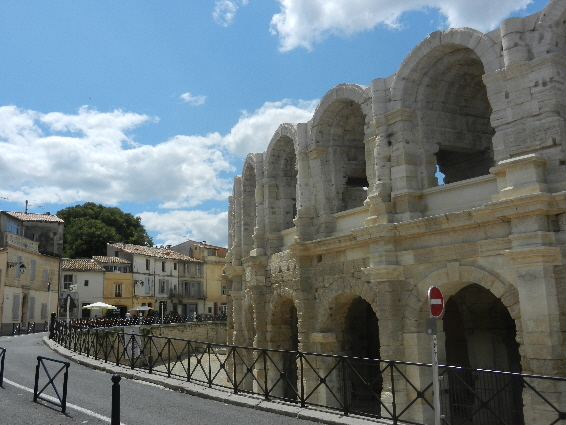
Which brings me to Arles, where there is a 2000-year-old Roman coliseum.  They hold bullfights here too, but back in the (Roman) day, 20,000 spectators watched as gladiators battled it out.


Old ways.

I drove home to pretty, quiet Aix-en-Provence, enjoyed a glass of Côtes de Provence, and called it a day.


So how do you follow up a bullfight in the Camargue?  How about a visit to the former center of papal power in Avignon -- Le Palais des Papes?

Popes in France?

Oui.

It goes something like this...  In 1305, a Frenchman, Bertrand de Got, was elected pope, and became Clement V.  Apparently it was not a lot of fun being a French pope in Rome with a lot of...unsupportive Italian cardinals, so Clement V moved the Papacy to Avignon.

This was not a French flash in the pan.  Clement V subsequently appointed a number of French cardinals and they, in turn, elected more French popes.  All told, seven popes ruled from Avignon from 1309-1377.  Later, two antipopes returned to Avignon and lived there until 1403.


The building is the product of successive additions and tear-downs, showing the scars of hundreds of years of French political history.

Not surprisingly, there is a treasury with walls three meters thick and hidden compartments in the floor.  Would you guess that there was also an orchard, a garden, and several large kitchens?  There was also an enormous dining room, where a nice German lady took my photo...


What took my breath away, though, was the cathedral.  I love Gothic architecture.  It is both dramatic and simple.  I thought this big, soaring space was exquisite...


And while stained glass is not the point here, I was captivated by the light cast by one of the windows...


Also, I was surprised and moved by the sample of Ars Nova music on the audioguide.  Ars Nova was championed by the Avignon popes and was a break from the Gregorian Chants we all know and love.  The principle composer of Ars Nova was Guillaume de Machaut.  This is so beautiful (and spooky), it gives me goosebumps...


Outside of the Palais, the Festival d'Avignon was in full swing, and actors staging impromptu performances were around every corner.  I happened upon this group with black umbrellas, milling silently around a cafe...


Back to the tiny Toyota, back to Aix.

E and I wandered the streets of the old town, puzzling at the tired-looking food on people's plates.  E kept saying, "Aren't we in the most famous food region of the most famous food country in the world?"  Aix may be more a tourist town than it is part of France.  The restaurants show it.  We settled on pizza at Chez Jo's, which wasn't half bad...


Next day, let's see...Luberon hill towns?

I drove to Gordes, a 2000-year-old village perched high on a rocky hill overlooking the Luberon Valley, where the crème de la crème of Paris society have summer homes.  Gordes is on the list of Most Beautiful Villages and France.  And what do you suppose I found?  


I suppose those guys were taking a picture that looked like this...


(Photo credit to this guy.)  I could not stop my car without surrendering to valet parking, so drove on to Roussillon.  Unfortunately, Roussillon is also "Most Beautiful" and parts of A Good Year with Russell Crowe were filmed there...  I refer you to that movie for images of Roussillon because, again, I did not stop.  The town was teeming with people.


What about Bonnieux? Russell had been here too, but so far the town has been spared a "Most Beautiful" listing, so I was able to find parking and crawl over the other gawkers to a quiet corner with pretty views over the valley.


On the next hill over, I could see an old chateau clinging to the rock.  What's that?  That, my friends, was the former home of the Marquis de Sade.  A marquis, incidentally, was a title among French nobility, marquis falling below duc, but above comte, vicomte, and baron.  I was first introduced to the Marquis de Sade by Angela Carter's radical book The Sadeian Woman, which argues that Sade's Justine and Juliette were some of the first feminist characters in fiction. 

I know very little about the life of the Marquis de Sade.  Francine du Plessix Gray, who wrote a biography called At Home with the Marquis de Sade, said this in Slate:

"The Marquis de Sade, who was born in 1740 and died in 1814, was a passionate gourmet, and especially loved baked apples and vanilla custards for dessert."

"Sade...was just as finicky about his clothes, and also wrote his wife from jail that he wished for 'a little prune-colored coat, with suede vest and trousers, something fresh and light but specifically not made of linen.'"

"He was equally particular about matters of personal hygiene and liked to bathe every day — a habit totally foreign to his 18th century contemporaries."

"He loved dogs."

Hmm.  That's his house?  Up there?


Reaching the top of the road, I was pleasantly surprised to find that Lacoste was not mobbed with Russell Crowe tourist traffic.  Preceding on foot through the pretty village, I was surprised to find...

An exhibition of new work by Kiki Smith and Valerie Hammond, two top-of-their-game contemporary artists.


It turns out that Savannah College of Art, a very good US-based design school, has made Lacoste one of its four outposts worldwide.  The others?  Savannah (Georgia), Atlanta (Georgia), and...Hong Kong.  Sham Shui Po, specifically ;-)

So anyway, up the hill I go, over slippery cobblestones, and am greeted at the top with open arms.  Enormous black open arms.


This sculpture by Russian artist Alexander Bourganov marks the entry to the ruins of the Château de Lacoste.  Do you know who owns the chateau?  Pierre Cardin.  I'm not making this up.  Music and dance performances for the Festival du Lacoste take place in the chateau.  This is so cool!

And the view from the Marquis' window is stunning.  I love it up here.  I'm so happy!


Pointing the tiny Toyota back at home, I found myself driving through more stunning scenery...  Don't underestimate the fun of plain old driving in Provence.  Just cruise and enjoy.  I wish E had come with me.


Another day, on the recommendation of a friend who lived in Aix, I wandered through the picturesque town of Ventabren, where there is a Michelin 1* called La Table de Ventabren.


But we didn't eat there.  What's up with that?  Well, after San Sebastian, where the food was delicious everywhere and surprisingly reasonable...the restaurant food in Provence was very disappointing.  Meanwhile the markets in Aix were so much fun...and I enjoyed snuffling out good charcuterie at Provence Viande and yummy bread at Le Farinoman Fou and exploring goodies at the plain old supermarket.  Here is some of yumminess we enjoyed at home...


And have I mentioned how nice everyone has been?  Reserved, but very nice and helpful. 

Anyway, cooking at home feels like old ways to me too.  And somehow, that's in keeping with the way people live here.  You see women walking back from the market with big open-topped baskets, in summer sandals and flowered dresses.  It could be anytime this century...  And I like that!